R&I systems are complex ecosystems which need various elements to perform optimally. The need for capacity strengthening is therefore not limited to individual and institutional capacity. It also requires mechanisms to attract and retain highly skilled staff, funding to support research and the R&I management function, seed funding for technology development and support for start-up company incubation, systems to report and record data etc.
This statement advocates for fair practice from conception to implementation of research and provides 20 recommendations aimed at all involved stakeholders. These recommendations are grouped under values that were identified as important underpinning considerations in discussion groups at the 7th WCRI. These values include diversity, inclusivity, mutual respect, shared accountability, indigenous knowledge recognition and epistemic justice (ensuring that the value of knowledge is not based on biases related to gender, race, ethnicity, culture, socio-economic status et cetera).
As the world reaches the halfway point of the United Nations’ 2030 Agenda for Sustainable Development, the focus on working towards the 17 Sustainable Development Goals (SDGs) is bringing about new interactions at the science–policy interface. As part of Goal 9 of this Agenda, countries have pledged to increase spending on R&D and the numbers of researchers by 2030.
This report is directly tied to the science, technology, and innovation (STI) agenda to meet the aspirations of African countries towards accelerating industrialisation and achieving rapid economic growth, with a view to uplift citizens’ livelihoods.
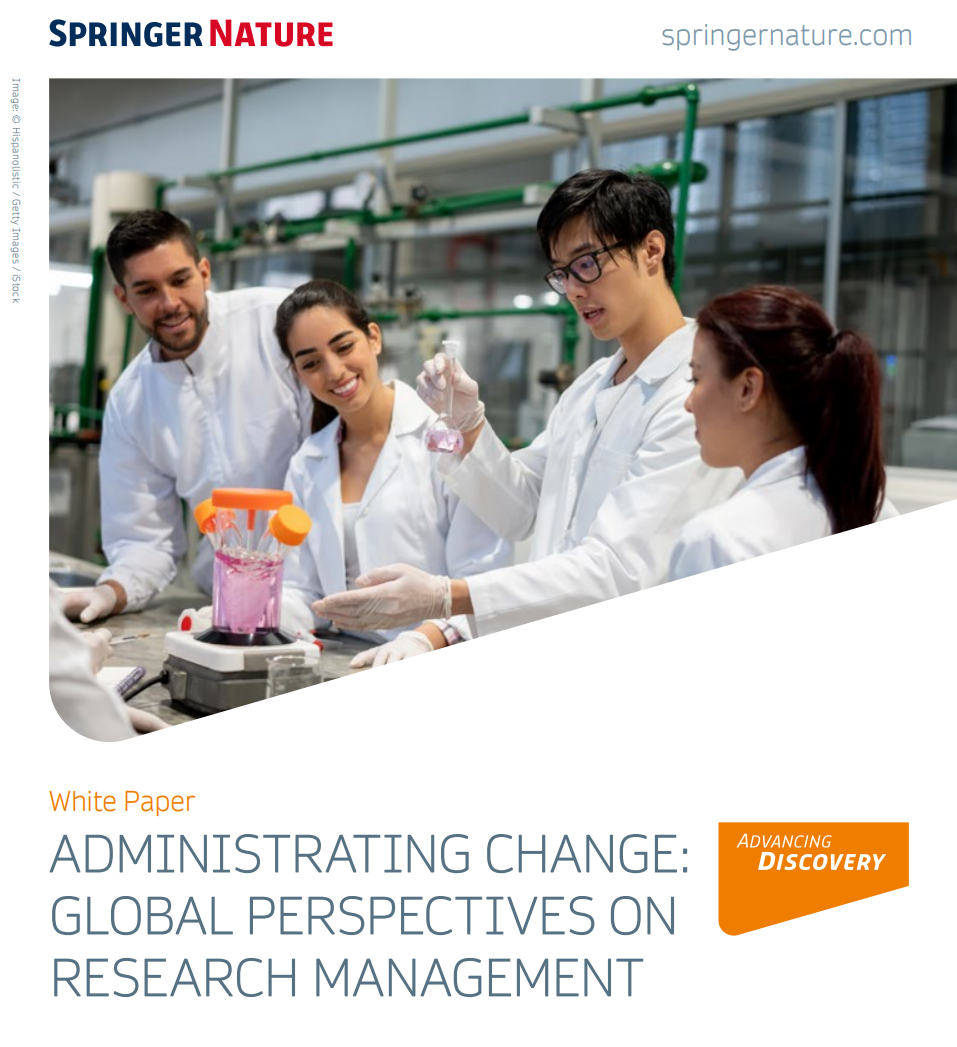
Research plays a major role in driving the discovery of solutions to the challenges faced across the globe. The growth in investments in research and development has skyrocketed over the last twenty years, promoting economic growth and driving competition for international research funding and staff.

2022 marks the 20th anniversary of existence of the Southern African Research and Innovation Management Association (SARIMA).
The structuring of the framework in nine distinct areas does not imply that these areas are not interlinked. It provides a structure to present the competencies within the areas that were identified by the practitioners as key areas in research management. The transferable (cross-cutting) competencies attempt to highlight those competencies that transcend the boundaries of the competency areas, in general or for a specific level of operation.
PCF tem como objectivo identificar um conjunto de áreas de competências-chave acordadas e as competências relacionadas para gestores e administradores de investigação. Além disso, tem por objectivo unir os profissionais, promovendo uma compreensão mútua da evolução da profissão.
Le Cadre de compétences professionnelles (CCP) a pour objectif d’identifier les principaux domaines de compétences homologuées et les compétences correspondantes pour les gestionnaires et administrateurs de la recherche. Il vise en outre à unir les praticiens et les professionnels en favorisant une compréhension mutuelle de l’évolution de la profession.

On the science, technology and innovation (STI) front, the 1996 White Paper on Science and Technology was introduced. More than 20 years have passed since then, and the global and local economies have seen major shifts. Rapid technological advancement and the Fourth Industrial Revolution (4IR) require updated STI policy responses for South Africa to thrive in this changing environment. The 2019 White Paper on Science, Technology and Innovation is therefore intended to position the national system of innovation (NSI) to increase the contribution of STI to addressing the socio-economic challenges faced by South Africa.

Encompassing conceptual elements of the research grant management and funding cycle, the manual identifies key practices and provides examples and templates to implement each key practice for each element. The Manual was developed by SARIMA under the Science Granting Councils Initiative as the “go-to” document for professionals in research management within the Science Granting Councils and the broader community.

Encompassing conceptual elements of the research grant management and funding cycle, the manual identifies key practices and provides examples and templates to implement each key practice for each element. The Manual was developed by SARIMA under the Science Granting Councils Initiative as the “go-to” document for professionals in research management within the Science Granting Councils and the broader community.

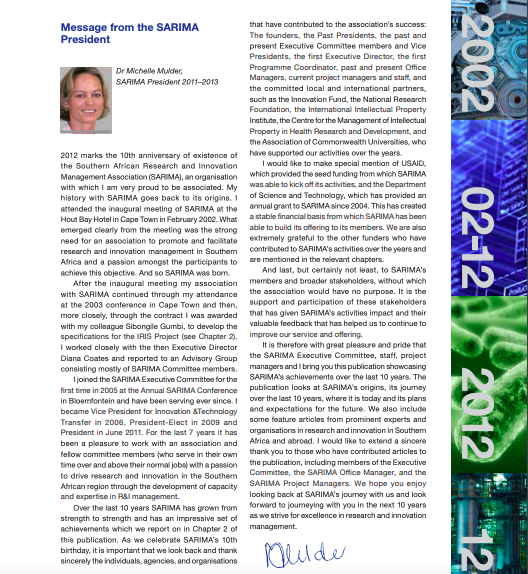
2012 marks the 10th anniversary of existence of the Southern African Research and Innovation Management Association (SARIMA).
Running research competitions encompasses a wide range of activities from designing the call to peer-review and award to monitoring, evaluation and learning. This good practice guideline offers guidance on the criteria that can be used to ensure that research competitions are of high quality.
This guideline was developed by SARIMA in 2017 under Theme 1 of the Science Granting Councils Initiative, funded by the United Kingdom’s Department for International Development (DFID), Canada’s International Development Research Centre (IDRC), and South Africa’s National Research Foundation (NRF).
Research Manager’s Notebooks
A six part series of notebooks developed for Research Managers and which offers guidelines and advice on writing successful grant proposals, project management, facilitating research partnerships, intellectual property and information sharing.
The notebooks were first published in 2013 by Research Africa. Produced under the RIMI4AC Project funded by the European Commission’s Africa, Caribbean and Pacific Science and Technology Programme. Grant no. FED/2009/218782.

This Research and Innovation Management Handbook has been developed by the Southern African Research and Innovation Management Association (SARIMA) primarily to assist research and innovation managers to be more effective in their multi-faceted and important roles. The disciplines of Research Management, on the one hand, and Technology Transfer and Innovation Management, on the other, converge, overlap and even co-exist in the some contexts; and from the perspective of the value chain they have strong inter-dependencies and complementarities. Nonetheless, for convenience the Handbook is divided into two complementary modules. This module concerns itself with Research Management, while its sister module is focused on Technology Transfer and Innovation Management.
Research Management is recognised across the world to be a highly diverse and eclectic mix of responsibilities. In Southern Africa it is evolving into a bespoke profession with its own body of knowledge, set of principles, linked associations, formal qualifications, and human resources descriptions and specifications.
The purpose of this Handbook is twofold. Firstly, it is to provide support and encouragement to research and innovation managers to familiarise themselves with best international practice through the provision of a range of online resources, that is by no means exhaustive, but sufficient to orientate the beginner and also challenge the experienced practitioner. Secondly, the purpose is to grow and develop research and innovation management in the SADC region, through the development of individuals.