
 March2020
Please note: The workshop have been posponed due to the ongoing COVID-19 concerns. Please be sure to follow the SARIMA website as well as our social media pages for the upcoming announcement regarding the new dates.
SARIMA welcomes you to register for our first face-to-face course on Traditional Knowledge Systems and Biological Resources.
According to the World Intellectual Property Organisation (WIPO), traditional knowledge (TK) is a living body of knowledge passed on from generation to generation within a community and often forms part of a people’s cultural and spiritual identity. TK is not static and is constantly developing in thriving communities. Biological resources, on the other hand, refers to any biotic component found within an ecosystem with actual or potential value. In many cases, biological resources and TK overlap, such as in the realm of traditional medicine.
According to the World Intellectual Property Organisation (WIPO), traditional knowledge (TK) is a living body of knowledge passed on from generation to generation within a community and often forms part of a people’s cultural and spiritual identity. TK is not static and is constantly developing in thriving communities. Biological resources, on the other hand, refers to any biotic component found within an ecosystem with actual or potential value. In many cases, biological resources and TK overlap, such as in the realm of traditional medicine.
Historically, communities have been exploited by companies that, for example, use indigenous biological resources and traditional knowledge to discover molecules for drug development with no or little consideration for the preservation of the biological resource or for rewarding the communities who have the knowledge that prompted the research. Patents for isolated molecules are being sold or licensed for several millions of dollars with no or little benefit flowing back to the country or community of origin.
Nations rich in TK and biodiversity grapple with how to preserve, protect and commercialise TK and biological resources and how to effectively reward communities and individuals. Several international conventions have been created to provide legal frameworks for the protection of biological resources and benefit share. However, it is up to each country to implement laws to that affect. It is also far from clear how to effectively protect traditional knowledge in a legal sense. On the one hand conventional IP protection may facilitate commercialisation of TK, but on the other hand global disclosure of knowledge may not be in the best interest of local communities who may prefer to guard community secrets. Are conventional IP Systems developed in the West adequate or are sui generis systems required? This course will look at IP protection strategies currently available for TK.
Nations rich in TK and biodiversity grapple with how to preserve, protect and commercialise TK and biological resources and how to effectively reward communities and individuals. Several international conventions have been created to provide legal frameworks for the protection of biological resources and benefit share. However, it is up to each country to implement laws to that affect. It is also far from clear how to effectively protect traditional knowledge in a legal sense. On the one hand conventional IP protection may facilitate commercialisation of TK, but on the other hand global disclosure of knowledge may not be in the best interest of local communities who may prefer to guard community secrets. Are conventional IP Systems developed in the West adequate or are sui generis systems required? This course will look at IP protection strategies currently available for TK.
Specific discussion points will include:
- Definitions and Legal Context
- Broad overview of conventional IP Systems
- IP Protection for Traditional Knowledge Systems (TKS)
- South African TKS Landscape, Bioprospecting and Benefit Sharing (BABS)
- Commercialisation of Biological Resources and Biobanks
- Developing a National Strategy for TKS: SADC focus
- Several Case Studies on Protection and Commercialisation of TKS and Biological Resources
Dates: Updated time and date to be announced
Venue: Garden Court ORT (Johannesburg)
Price: R3950 (SARIMA members), and R4950 (non-members)
Venue: Garden Court ORT (Johannesburg)
Price: R3950 (SARIMA members), and R4950 (non-members)
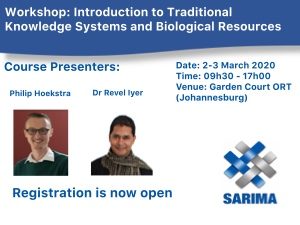
Course Presenters:
Philip Hoekstra
Philip Hoekstra

Philip Hoekstra is the IP Manager at the University of Cape Town’s Department of Research Contracts and Innovation (RC&I). He has worked at RC&I for over 6 years, and prior to that built up experience in R&D, IP, contracts, technology commercialisation and market research whilst working at Von Seidels IP Attorneys, Optimal Energy (a start-up company), Frost & Sullivan and AECI. Philip presented SARIMA courses on IP, Technology Transfer and Traditional Knowledge Systems in various SADC countries, including Malawi, Swaziland and Mozambique. Philip is a past committee member of SARIMA and presently serves on the international committee of the International Technology Transfer Network (ITTN) based in China. Philip is a Registered Technology Transfer Professional (RTTP).
Dr Revel Iyer

Dr Revel Iyer has a long career in the university environment in a wide range of roles. As a researcher he was involved in various fields of biotechnology research culminating in him leading the transgenic maize research program at the University of Cape Town (UCT). As an inventor he was involved in the development of a basket of technologies directed at genetically engineering drought tolerance in plants. In addition to his scientific qualifications Revel also obtained an LLB degree with electives including intellectual property law, forensic medicine and environmental law, an LLM in Intellectual Property Law and an MBA. In October 2016, Revel joined Cape Peninsula University of Technology as Director of the Technology Transfer Office.

